
Why static electricity requires more than bonding and grounding
Static electricity is one of the recognized ignition sources capable of initiating fires and explosions in industrial facilities. Yet electrostatic ignition hazards are frequently misunderstood.
A bonding cable may be installed and the hazard considered solved. A high laboratory-measured minimum ignition energy may be interpreted as evidence that explosion protection is unnecessary. Gas flowing through equipment may automatically be blamed whenever an unexplained ignition occurs. These conclusions can be misleading.
An effective electrostatic hazard assessment requires understanding how charge is generated, where it can accumulate, what type of electrostatic discharge can occur, and whether that particular discharge can ignite the combustible atmosphere.Industrial ignition sources are not limited to static electricity. Potential mechanisms include hot surfaces, flames, mechanically generated sparks, electrical equipment, lightning, electromagnetic radiation, adiabatic compression, and chemical reactions. Understanding which source is credible is a fundamental part of fire and explosion risk assessment.
| Ignition sources | |||||
| 1 | Hot surfaces | ||||
| 2 | Flames and hot gases (including hot particles) | ||||
| 3 | Mechanically generated sparks | ||||
| 4 | Electrical apparatus | ||||
| 5 | Stray electrical currents, cathodic corrosion protection | ||||
| 6 | Static electricity | ||||
| 7 | Lightning | ||||
| 8 | Radio frequency (RF) electromagnetic waves from 104 Hz to 3 x 10¹² Hz | ||||
| 9 | Electromagnetic waves from 3 x 10¹¹ Hz to 3 x 10¹⁵ Hz | ||||
| 10 | Ionising radiation | ||||
| 11 | Ultrasonics | ||||
| 12 | Adiabatic compression and shock waves | ||||
| 13 | Chemical reactions, including self-ignition of dusts | ||||
This article examines five common myths surrounding electrostatic ignition sources and explains why a systematic engineering approach is necessary.
What is required for an electrostatic ignition
An electrostatic discharge by itself does not necessarily create a fire or explosion. The familiar fire triangle requires three elements:
- Combustible fuel.
- An oxidizing atmosphere, usually oxygen in air.
- An ignition source capable of initiating combustion.
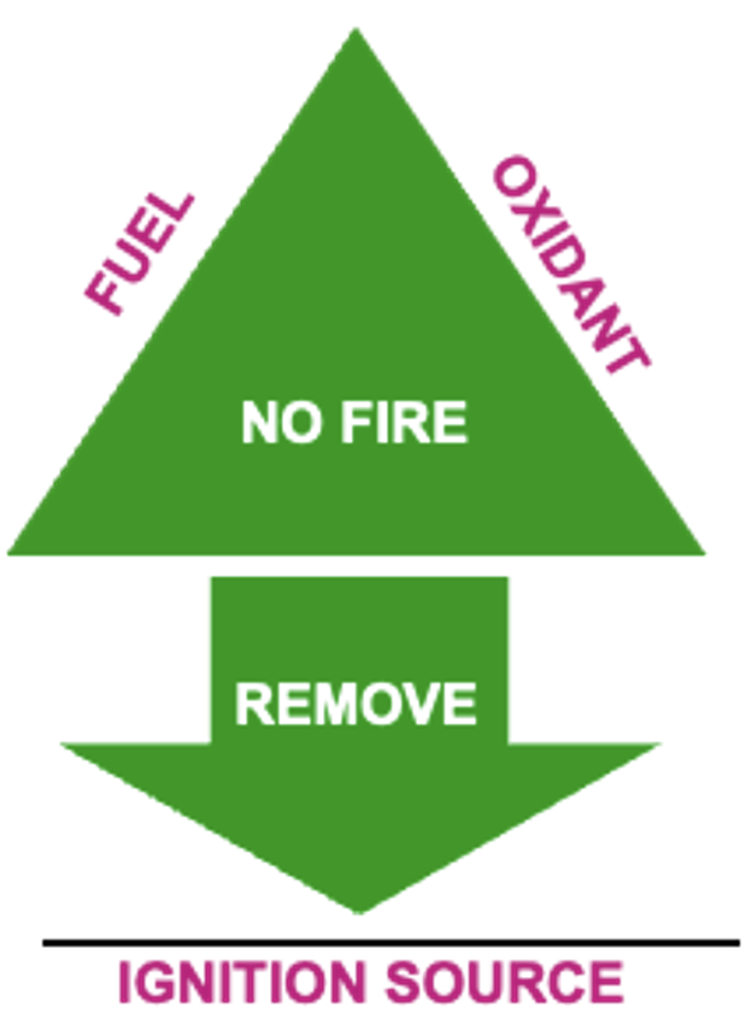
An ignition source is an energy source capable of initiating a combustion reaction. As illustrated in Figure 1, preventing an effective ignition source interrupts the fire triangle, provided other credible ignition sources are also controlled.
For an electrostatic discharge to become a credible ignition source, HazBasis recommends systematically addressing five questions:
- Is a flammable or explosible atmosphere present?
- Is there a mechanism capable of generating electrostatic charge?
- Can the generated charge accumulate?
- Can an electrostatic discharge occur, and what type would it be?
- Does that discharge have sufficient incendive capability to ignite the atmosphere?
These questions provide a defensible basis for an electrostatic risk assessment by connecting the presence of static electricity to an actual ignition mechanism.
Myth 1: Bonding and grounding solve all electrostatic problems
Bonding and grounding are among the most important controls for electrostatic hazards, but they do not eliminate every electrostatic ignition mechanism.
What bonding and grounding do
Bonding electrically connects conductive objects so that significant potential differences do not develop between them. Grounding provides conductive equipment with an electrical path to earth so that accumulated charge can dissipate.
These controls can be highly effective for metal drums, vessels, conductive piping, transfer equipment, portable containers, and other conductive objects capable of becoming isolated. However, they are primarily effective when the charged object itself is sufficiently conductive.
Where bonding and grounding may not be enough
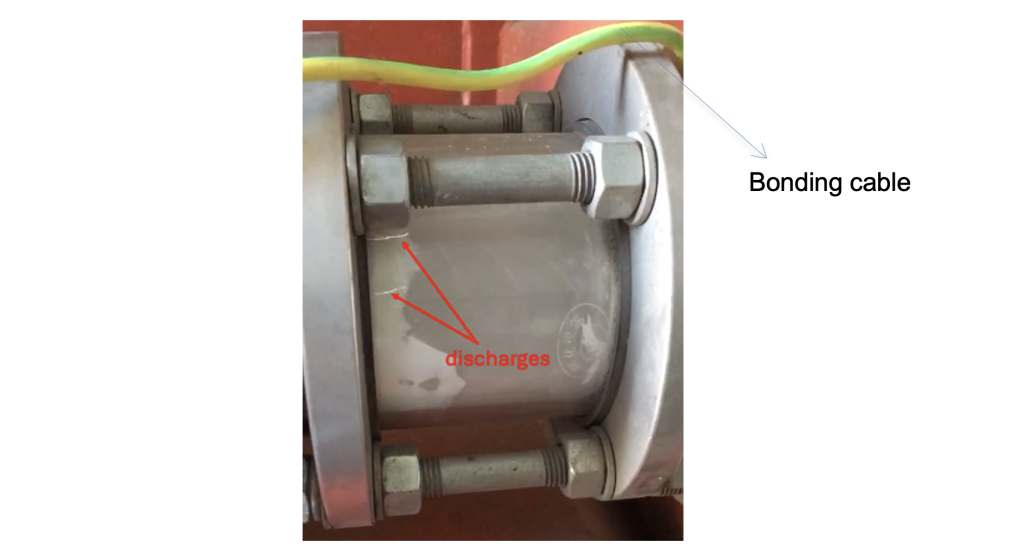
Static charge can also accumulate on plastic equipment, polymer liners, flexible intermediate bulk containers, insulating hoses, nonconductive coatings, insulating powders, personnel wearing unsuitable footwear, and surfaces isolated from conductive equipment.
An insulating surface does not become conductive merely because an adjacent metal component is grounded. Depending on geometry and charge density, insulating materials can produce electrostatic discharges that require controls beyond conventional bonding and grounding, as demonstrated in Figure 2.
Practical lesson
Evaluate more than the presence of a bonding and grounding connection. Determine which materials can charge, whether they are conductive or insulating, how charge can dissipate, and where it can accumulate. Then identify the possible discharge mechanism and whether it can ignite the material being handled.
Bonding and grounding should form part of an electrostatic control strategy. The assessment must also address the materials and discharge mechanisms they cannot control.
Myth 2: Laboratory MIE can be applied directly to plant conditions
Minimum ignition energy, or MIE, is an important input to combustible dust and electrostatic ignition assessments. The result must be interpreted together with the conditions under which it was obtained.
What minimum ignition energy measures
For combustible dusts, MIE characterizes the energy needed to ignite a dust cloud at its most easily ignitable concentration using a specified spark test. ASTM E2019 expresses that energy as electrical energy stored in a capacitor before discharge. The result is specific to the sample, test method, and equipment.
An industrial process is rarely identical to a standardized laboratory apparatus. The sample condition and the way a real discharge transfers energy to the atmosphere both matter.
Why industrial conditions matter
The incendivity of a real discharge can depend on:
- Discharge type, electrode geometry, capacitance, and voltage.
- Discharge duration, energy density, and the spatial distribution of energy.
- Dust concentration, particle size, moisture, temperature, and turbulence.
- Process geometry and atmospheric composition.
The same nominal energy does not automatically mean the same ignition capability.
An example of how to interpret MIE
Suppose a powder has a reported MIE of 10 mJ. It would be incorrect to conclude that every electrostatic phenomenon with an estimated energy above 10 mJ will necessarily ignite the dust cloud. Conversely, an estimated discharge energy below 10 mJ does not, by itself, rule out ignition when the actual process conditions or discharge characteristics differ from those used during MIE testing.
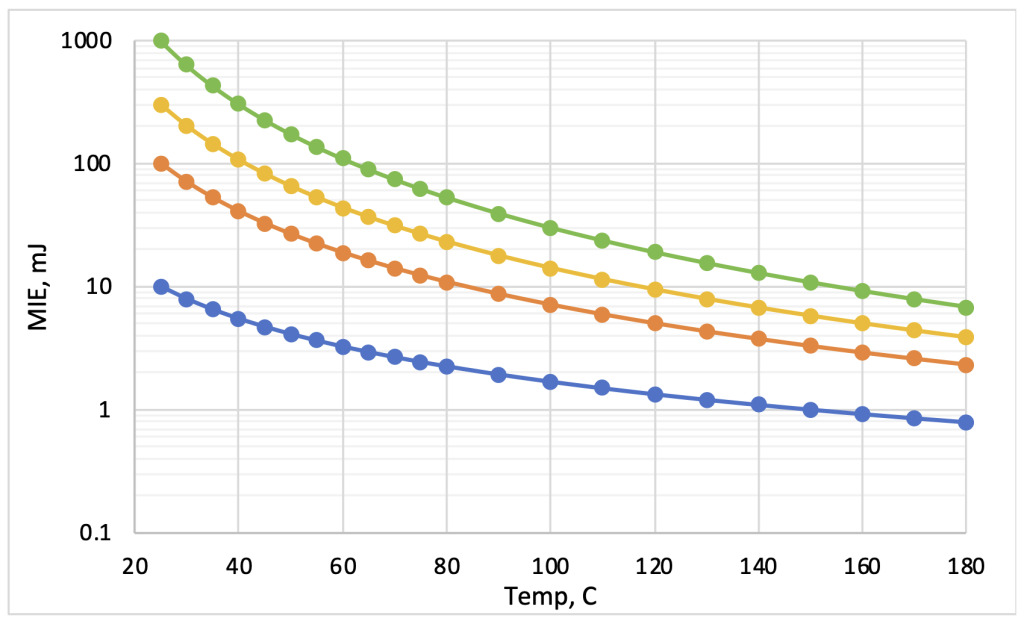
As demonstrated in Figure 3, the MIE of a combustible dust can be temperature dependent. In general, an increase in dust-cloud temperature may reduce the energy required for ignition. Therefore, if the actual operating temperature is higher than the temperature at which the reported MIE was measured, an electrostatic discharge with an energy below the reported MIE may still be capable of igniting the dust cloud. Accordingly, MIE values should be applied with consideration of the actual process temperature and other relevant operating conditions rather than treated as an absolute ignition threshold.
The discharge mechanism matters. Spark discharges, brush discharges, propagating brush discharges, corona discharges, and other electrostatic phenomena do not transfer energy in the same way.
Practical lesson
Use MIE as an input to the assessment, together with the credible discharge mechanism and process conditions. HazBasis evaluates the relationship between material ignition sensitivity and the possible discharge, rather than relying on a comparison of two numbers without physical context.
Learn more about minimum ignition energy testing and how laboratory results support engineering decisions.
Myth 3: Dust explosion protection is unnecessary when MIE exceeds 1000 mJ
A relatively high MIE does not mean a combustible dust cannot cause a fire or explosion. Materials such as carbon black, activated carbon, and PVC can exhibit relatively high MIE, although actual results depend on the grade and sample condition.
MIE addresses sensitivity to a particular spark ignition mechanism. It does not determine whether a material is combustible or whether other ignition sources are credible.
MIE and explosion severity answer different questions
Combustible dust hazard assessment considers several properties. Ignition sensitivity parameters include MIE and the minimum ignition temperatures of dust clouds and dust layers. Explosion severity parameters include maximum explosion pressure (Pmax), maximum rate of pressure rise, and the dust deflagration index (Kst).
A dust requiring relatively high spark energy to ignite can still produce a serious deflagration once ignition occurs.
The Titan Tire carbon black incident
On October 4, 1999, a mixer at Titan Tire Corporation of Natchez released a cloud containing carbon black dust into the workplace. The cloud ignited, and the resulting flash fire seriously burned two employees. The official record describes oil contamination in the carbon black mixture and states that the actual ignition source was not determined.
This case illustrates why the material and conditions in the plant must be evaluated. A general expectation of low spark sensitivity cannot establish that a process dust mixture is safe.
Multiple ignition sources must be considered
Potential ignition sources include hot surfaces, flames, hot particles, mechanically generated sparks, electrical equipment, static electricity, lightning, adiabatic compression, shock waves, exothermic reactions, and self-heating.
High MIE does not establish noncombustibility or automatically remove the need for explosion protection. A Dust Hazard Analysis must evaluate the overall combustible dust hazard and the applicable prevention and protection measures.
Myth 4: A brush discharge will ignite any dust with MIE below 4 mJ
This misconception illustrates why comparing a discharge energy with laboratory MIE can be misleading. Brush discharges from charged insulating surfaces have been assigned equivalent energies of approximately 1–4 mJ based on their ignition behavior in flammable gases. That comparison does not establish a universal dust ignition threshold.
It might seem logical to assume that a dust with an MIE below the brush discharge’s equivalent energy must ignite. Experimental research shows a more complicated relationship.
Work by Schwenzfeuer and Glor examined dust ignition by brush discharge. Later research discussed in the presentation identified differences in discharge waveform and power density, as well as the effect of dust on the electric field. These differences help explain why powders behave differently from flammable gases.
Why discharge type matters
A spark discharge and a brush discharge do not necessarily deliver energy to the combustible atmosphere in the same manner. Ignition capability can depend on spatial energy distribution, discharge duration, local energy density, voltage, field geometry, fuel properties, and dispersion conditions.
Ordinary brush discharges must also be distinguished from propagating brush discharges. Hybrid mixtures and oxygen-enriched atmospheres require separate evaluation. A conclusion about one discharge type and atmosphere should not be extended to a different combination.
Practical lesson
Identify what type of discharge can actually occur before judging its incendivity. A comparison of MIE and nominal discharge energy is insufficient without that physical basis.
Myth 5: Gas flow alone explains electrostatic ignition
Gas release incidents, particularly those involving hydrogen, are sometimes attributed to static electricity when the ignition mechanism is not immediately obvious. However, clean gas flow itself is generally a poor charge-generation mechanism.
NFPA 77 guidance explains that clean gas flowing over a solid surface produces negligible charging. This does not mean electrostatic charging can never accompany gas systems. Particulates, liquid droplets, contaminants, and other process conditions can change the situation.
Observing high-velocity gas flow is therefore insufficient evidence to conclude that an electrostatic discharge caused an ignition.
High pressure releases can involve other ignition mechanisms
Research on spontaneous ignition of pressurized hydrogen and natural-gas releases has examined the effects of pressure and geometry. Under the particular conditions studied, the observed behavior was inconsistent with electrostatic discharge as the ignition explanation. Shock-induced ignition mechanisms have been investigated for such releases.
An ignition-source investigation should be based on physical evidence and engineering analysis. Questions should include:
- Was charge generation physically credible, and could sufficient charge accumulate?
- What conductive and insulating objects were present?
- Could a discharge occur, and what type was possible?
- Could that discharge ignite the actual atmosphere?
- Are thermal, mechanical, electrical, chemical, or compression-related mechanisms more credible?
How an electrostatic ignition hazard assessment is performed
A systematic assessment begins with the combustible atmosphere and follows the charge-generation and discharge mechanisms. Key inputs include MIE, volume resistivity or electrical conductivity, surface resistivity, chargeability, and the type of electrostatic discharge.
Can dangerous static charge be generated
Charging can occur during liquid transfer, powder conveying, pneumatic transport, filtration, mixing, grinding, separation, pouring, filling, spraying, personnel movement, and contact and separation between materials.
Can the charge accumulate
Charge retention depends heavily on conductivity and resistivity. Conductive objects may dissipate charge rapidly when properly grounded. Insulating materials may retain charge much longer.
Can the accumulated charge produce an incendive discharge
The answer depends on stored charge, capacitance, voltage, geometry, conductivity, discharge type, and the ignition sensitivity of the surrounding atmosphere. These factors establish whether an electrostatic ignition source is credible for the particular operation.
Electrostatic hazards in combustible dust operations
Powders can become highly charged through contact and separation. Operations deserving attention include powder transfer, pneumatic conveying, bag dumping, drum filling, blender and mixer charging, sieving, screening, dust collection, milling, bulk bag filling and unloading, vacuum conveying, and powder packaging.
Depending on the powder and process, charge may develop on the powder itself, equipment surfaces, containers, or personnel. For combustible powders, electrostatic evaluation should form part of the broader Dust Hazard Analysis.
Electrostatic hazards with flammable liquids and vapors
Static electricity can create significant risks during flammable liquid transfer. Relevant operations include tank and drum filling, splash filling, filtration, pumping, agitation, sampling, road tanker loading, intermediate bulk container transfer, and transfer through hoses.
An assessment may need to address liquid conductivity, flow velocity, residence or relaxation time, container conductivity, grounding continuity, splash generation, mist formation, insulating liners and coatings, and vapor concentration. Appropriate controls depend on the actual process configuration.
Why identifying the correct ignition source matters
Incorrectly identifying static electricity as the ignition source can lead to ineffective corrective actions. If a fire began at a hot bearing, electrical device, friction point, self-heating deposit, or exothermic reaction, additional bonding cables may do little to address the initiating mechanism.
Conversely, overlooking a genuine electrostatic ignition mechanism can leave a serious hazard uncontrolled. An electrostatic ignition explanation should be supported by a credible sequence of charge generation, accumulation, discharge, and ignition.
Five electrostatic ignition myths at a glance
| Myth | Engineering interpretation |
| Bonding and grounding eliminate all static hazards. | They control charge on conductive objects but do not address every charging and discharge mechanism. |
| Laboratory MIE applies directly to plant conditions. | Interpret MIE with the actual sample, process conditions, and discharge mechanism. |
| Dust with MIE above 1000 mJ needs no explosion protection. | High MIE does not establish noncombustibility or eliminate other ignition sources. |
| Brush discharges ignite every dust with MIE below 4 mJ. | Ignition capability depends on discharge physics and atmosphere, not a nominal energy comparison alone. |
| Gas flow alone explains electrostatic ignition. | Clean gas flow produces negligible charging; contaminants and other ignition mechanisms require evaluation. |
Need help evaluating electrostatic ignition hazards?
Electrostatic hazards can be underestimated or overestimated when the assessment stops at bonding and grounding or interprets laboratory data without examining the discharge mechanism.
HazBasis Process Safety provides engineering and laboratory support for facilities evaluating electrostatic ignition hazards associated with combustible dusts, powders, flammable liquids, gases, and process equipment.