
Combustible Dust Can Turn an Ordinary Process Into a Major Explosion Hazard
Flour. Sugar. Wood dust. Plastic powder. Aluminum. Pharmaceutical ingredients. Carbonaceous materials. Chemical powders.
Many materials that appear harmless in bulk form can become serious fire, flash-fire or explosion hazards when reduced to fine particles.
OSHA identifies combustible dust hazards across industries including food processing, metals, plastics, rubber, wood, coal, pharmaceuticals, textiles and other operations that generate fine combustible particulate material.
The danger is not limited to visibly dusty processes. A small release inside a dust collector, mill, dryer, blender, conveyor, bucket elevator, silo, hopper or transfer point can produce an explosible dust cloud. A relatively small primary event can then disturb accumulated dust elsewhere in a building and create a much larger secondary dust explosion.
The U.S. Chemical Safety and Hazard Investigation Board identified 281 combustible-dust incidents between 1980 and 2005, resulting in 119 fatalities and 718 injuries.
Do not assume a powder is safe because it has been handled for years without an incident. Determine the hazard before the process finds it for you.
What Is Combustible Dust
Combustible dust is finely divided combustible particulate material that can create a fire or deflagration hazard under appropriate conditions.
- Flour, starch, sugar and grain dust
- Wood dust and biomass
- Coal and carbonaceous dust
- Plastic and polymer powders
- Rubber dust
- Pharmaceutical powders
- Chemical intermediates, resins and additives
- Aluminum, magnesium and other combustible metal powders
- Paper, cellulose fibers, pigments and specialty chemicals
The chemical name alone does not define the hazard. Particle size, moisture content, composition, morphology, processing history and operating conditions can substantially affect ignition sensitivity and explosion behavior. OSHA notes that dusts made from the same chemical material can exhibit different explosibility characteristics depending on physical properties such as particle size, shape and moisture.
That is why literature values or another facility’s test results should not automatically be treated as representative of your process material.
The Dust Explosion Pentagon: What Does a Dust Explosion Need?
A combustible dust explosion generally requires five elements: combustible dust, oxygen, an ignition source, dispersion and confinement. These five elements form the Dust Explosion Pentagon used by OSHA to explain the conditions necessary for a dust explosion.
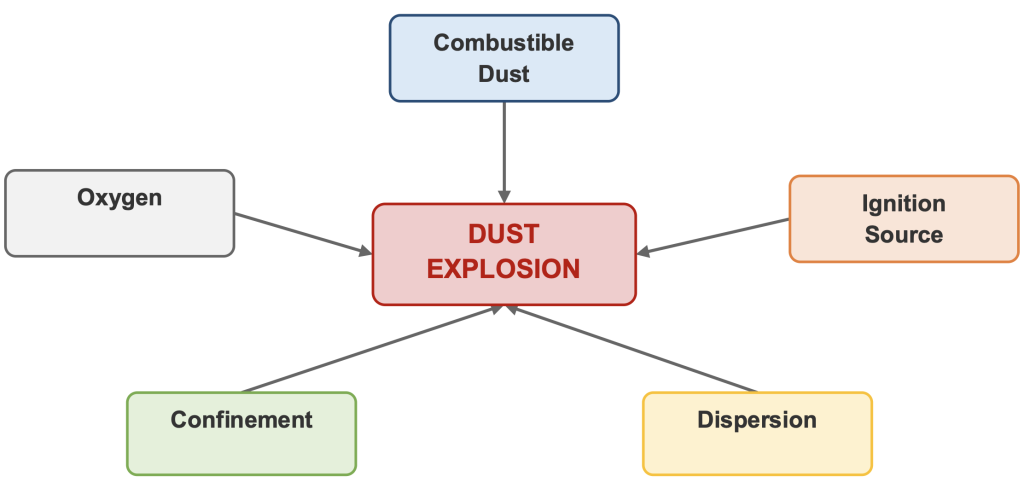
- Combustible dust – the fuel.
- Oxygen – air normally provides sufficient oxidizer.
- Ignition source – electrostatic discharge, electrical sparks, hot bearings, hot surfaces, friction, hot work, flame or smoldering material.
- Dispersion – the dust becomes airborne at a hazardous concentration.
- Confinement – pressure can develop during rapid combustion.
Removing or adequately controlling one or more of these elements is fundamental to dust explosion prevention.
Why Secondary Dust Explosions Can Be More Destructive Than the Initial Explosion
One of the most dangerous combustible-dust scenarios begins with a relatively small event. A primary explosion inside a dust collector or process vessel can generate a pressure wave that shakes accumulated dust from structural beams, cable trays, equipment surfaces, roof structures, ductwork, floors, ledges and lighting fixtures.Once suspended, this dust can form a much larger combustible cloud. If that cloud ignites, a secondary explosion can propagate through the building. The CSB has repeatedly identified secondary explosions as a critical escalation mechanism in major combustible-dust incidents.

Secondary explosion risk
Housekeeping is not simply an appearance issue. Accumulated combustible dust can represent stored fuel for the next explosion.
Is Your Dust Actually Explosible? Testing Should Answer the Question
One of the most common combustible-dust mistakes is trying to answer a material-property question through visual inspection or an SDS alone. A better approach is to test a representative material and select the test program based on the engineering question that must be answered.
Go/No-Go Explosibility Screening
A screening test determines whether the submitted dust can propagate a deflagration under specified test conditions. This is often the logical starting point when explosibility is unknown.
A No-Go result should not automatically be interpreted to mean that the material can never burn, smolder, self-heat or become hazardous under different particle-size or process conditions.
Kst and Pmax Dust Explosion Severity Testing
If a dust is explosible, Kst and Pmax help define the severity of the dust explosion.
Kst is the dust deflagration index and characterizes the normalized maximum rate of pressure rise. Pmax is the maximum explosion pressure measured under the specified test conditions.
- Explosion venting
- Explosion suppression
- Explosion-resistant equipment
- Dust collector protection
- Deflagration isolation
HazBasis performs dust explosion severity testing using recognized methods including ASTM E1226 and applicable EN 14034 methods.
Kst Is Important – But Kst Alone Does Not Define Dust Risk
A facility may know its Kst value and still have an incomplete understanding of the hazard. Different tests answer different engineering questions.
| Dust Property | Engineering Question | ||
| Go/No-Go | How rapidly can explosion pressure rise? | ||
| Pmax | What maximum explosion pressure can develop? | ||
| MIE | How easily can an electrical or electrostatic spark ignite the dust cloud? | ||
| MEC | What is the minimum dust concentration capable of supporting an explosion? | ||
| MAIT / MIT Cloud | What hot-surface temperature can ignite a dust cloud? | ||
| LIT / MIT Layer | What temperature can ignite a deposited dust layer? | ||
| LOC | How far must oxygen concentration be reduced to prevent ignition under the test conditions? | ||
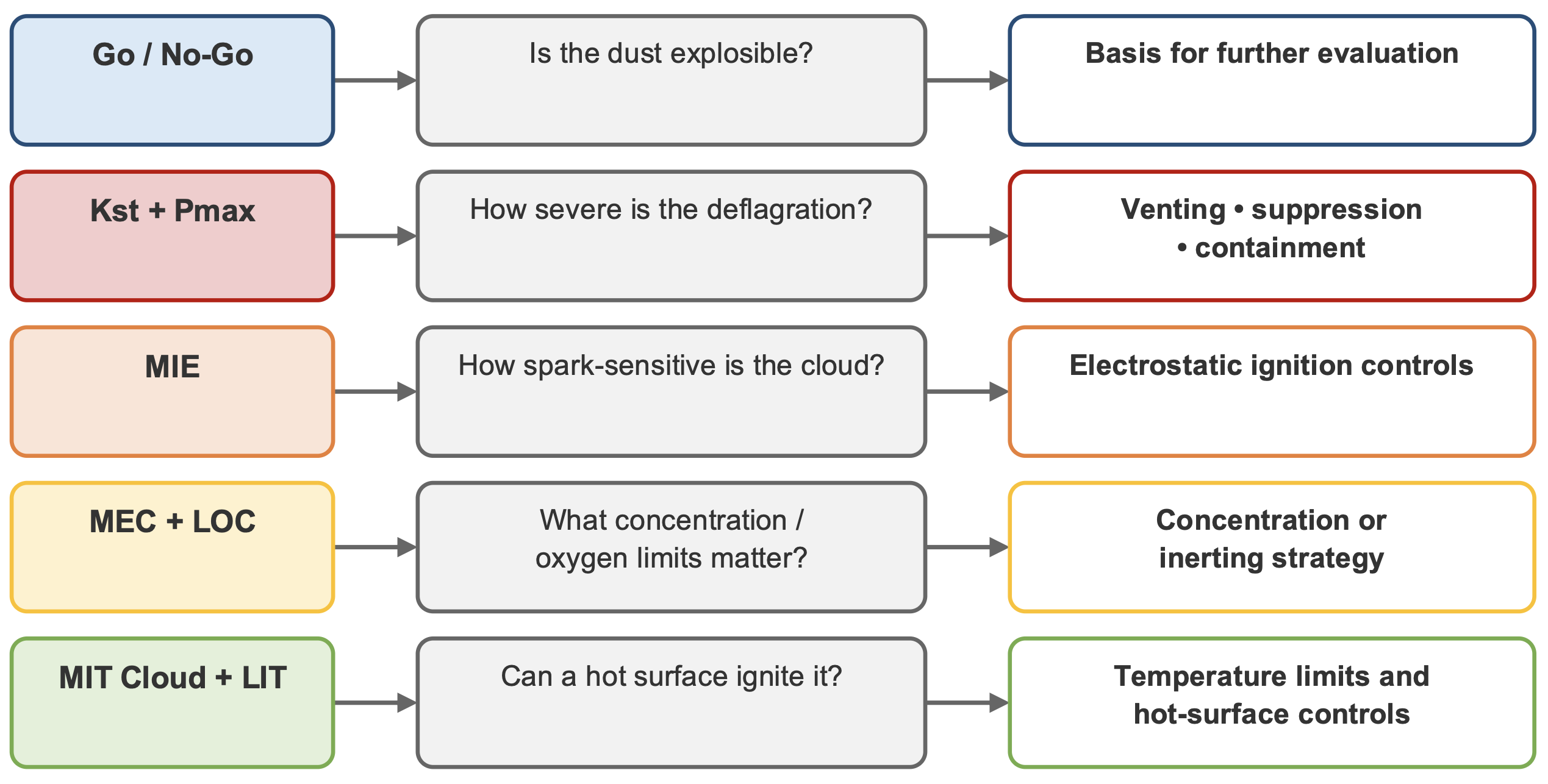
A well-designed testing program selects the properties needed for the actual engineering decision rather than ordering a standard package without understanding how the results will be used. HazBasis provides explosibility screening, Kst/Pmax, MIE, MEC, LOC, dust-cloud ignition temperature, dust-layer ignition temperature, particle sizing and related characterization.
Minimum Ignition Energy: When Static Electricity Becomes Important
Electrostatic ignition is frequently underestimated in powder processing. Operations such as pneumatic conveying, powder transfer, FIBC filling and unloading, sieving, grinding, mixing, plastic-container handling and vacuum conveying can generate electrostatic charge.
Whether a particular electrostatic discharge represents a credible ignition source depends partly on the ignition sensitivity of the dust. Minimum Ignition Energy (MIE) testing determines the lowest capacitive spark energy capable of igniting the tested dust cloud over the evaluated conditions. HazBasis uses ASTM E2019 for applicable MIE testing.
- Grounding and bonding
- Conductive equipment selection
- FIBC selection
- Personnel grounding
- Insulating components
- Electrostatic discharge control
- Ignition-source analysis
MIE should not be viewed in isolation. Hot surfaces, mechanical sparks, burning particles and other ignition sources require separate evaluation.
What Is NFPA 660
NFPA 660, Standard for Combustible Dusts and Particulate Solids, is the consolidated NFPA standard addressing combustible dust and particulate-solid fire and explosion hazards. The 2025 edition brings combustible-dust requirements previously distributed among multiple NFPA documents into a unified framework.
- Hazard identification
- Dust Hazard Analysis
- Hazard management
- Equipment design
- Building and process protection
- Ignition source control
- Dust collection
- Explosion prevention and protection
- Deflagration isolation
- Housekeeping
- Operating procedures
- Management systems
A major practical implication is that combustible-dust management should be based on a documented evaluation of actual hazards, not simply equipment labels or generic compliance checklists.
What Is a Dust Hazard Analysis
A Dust Hazard Analysis (DHA) is a systematic engineering review used to identify combustible-dust fire, flash-fire and explosion hazards and determine whether safeguards are adequate.
A strong DHA follows the complete hazard pathway from the material and process conditions through release, dispersion, ignition, consequence and safeguards.
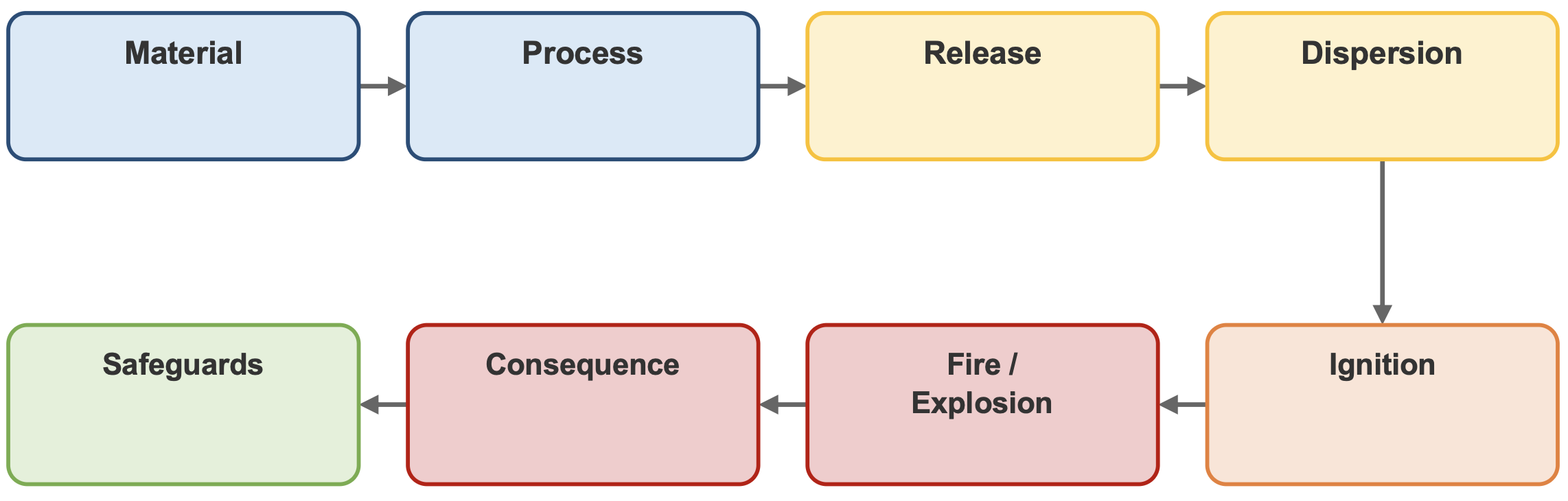
- Material explosibility data
- Dust generation points
- Powder transfer operations
- Dust collectors and baghouses
- Mills and grinders
- Dryers
- Mixers and blenders
- Bucket elevators
- Pneumatic conveying
- Silos and hoppers
- Packaging equipment
- Fugitive dust accumulation
- Ignition sources and electrostatic hazards
- Hazardous Area Classification
- Explosion venting, suppression, isolation and containment
- Housekeeping, maintenance, operating procedures and management of change
NFPA 660 includes Dust Hazard Analysis within its combustible-dust hazard management framework.
Seven Warning Signs Your Facility May Have a Combustible Dust Problem
1. Visible Dust Is Accumulating Outside Equipment
Fugitive dust means material is escaping containment. Ask where it is accumulating, whether it could become dispersed, what ignition sources are nearby and whether an initial event could disturb additional deposits.
2. Your Dust Collector Is Indoors
A dust collector concentrates combustible material and routinely produces suspended dust clouds internally. Its location, construction, explosion protection, isolation and exhaust configuration require careful evaluation.
3. You Have Kst Data but Do Not Know the Sample Condition
A Kst value without particle-size, moisture and sample-preparation information can easily be misapplied. The test material should represent the process condition relevant to the hazard being evaluated.
4. You Handle Powder Through Plastic Equipment or Flexible Hoses
Insulating materials can complicate electrostatic-charge dissipation. Grounding a metal component does not automatically eliminate every electrostatic ignition mechanism in a powder-handling system.
5. Your Process Includes Grinding, Drying or Pneumatic Conveying
These operations can simultaneously create finer particles, dispersible dust clouds and ignition sources. They deserve particular attention during a DHA.
6. You Have Never Performed Combustible Dust Testing
If the explosibility or ignition sensitivity of the material is unknown, major engineering decisions may be based on assumptions. Testing can establish the technical basis for the DHA and protection strategy.
7. Your Insurer, Fire Marshal, AHJ or Corporate Safety Group Is Asking for a DHA
This often means the organization needs documented evidence that the hazard has been systematically identified and controlled. A strong DHA should be technically defensible and practical enough to guide implementation.
Common Combustible Dust Mistakes
Mistake 1: “The SDS Does Not Say Combustible Dust, So We Are Safe.”
An SDS is useful information, but it may not contain all the test data required for facility-specific engineering decisions. Testing the actual process material is often the better technical basis.
Mistake 2: “Our Kst Is Low, So the Risk Is Low.”
Even a relatively low Kst does not mean an explosible dust can be ignored. OSHA notes that combustible dust with Kst greater than zero can be capable of deflagration. Risk depends on both likelihood and consequence.
Mistake 3: “Ground Everything and Static Is Solved.”
Bonding and grounding conductive objects are fundamental controls, but electrostatic hazards can also involve insulating surfaces, personnel, propagating brush discharges, powder charging, FIBC construction and highly ignition-sensitive dust.
Mistake 4: “The Explosion Vent Protects the Dust Collector, So We Are Done.”
Explosion protection and explosion isolation are different engineering functions. A protected dust collector can still transmit flame and pressure into interconnected equipment unless propagation pathways are properly addressed.
Mistake 5: “We Have Operated for 20 Years Without an Explosion.”
Past operation without an incident does not demonstrate the absence of a combustible-dust hazard. The 2008 Imperial Sugar dust explosion and fire resulted in 14 fatalities and 38 injuries. Hazards should be evaluated from the physical and process conditions, not from the absence of previous accidents.
A Practical Combustible Dust Risk-Reduction Strategy
A technically sound program generally follows a logical sequence. The objective is not to buy individual safety devices; the objective is to establish a defensible basis for why the process is safe.
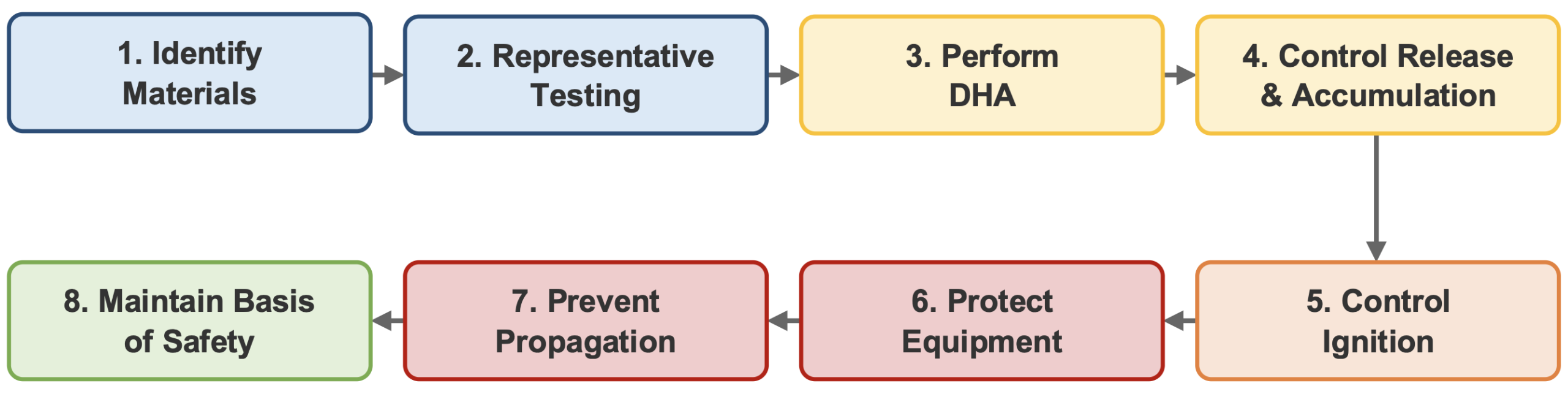
Step 1 – Identify the Materials: Determine which powders, fines, fibers and particulate solids could present combustible-dust hazards.
Step 2 – Obtain Representative Test Data: Determine what testing is needed to establish explosibility, severity and ignition sensitivity.
Step 3 – Perform a Dust Hazard Analysis: Evaluate where credible fire, flash-fire and explosion scenarios exist.
Step 4 – Control Dust Release and Accumulation: Improve containment, collection, ventilation and housekeeping.
Step 5 – Control Ignition Sources: Address electrical, mechanical, thermal and electrostatic ignition mechanisms.
Step 6 – Protect Process Equipment: Where prevention alone is insufficient, evaluate explosion venting, suppression, containment and other protection strategies.
Step 7 – Prevent Explosion Propagation: Evaluate deflagration isolation between interconnected process equipment.
Step 8 – Maintain the Basis of Safety: Integrate controls into operating procedures, inspection, maintenance, training and management of change.
Combustible Dust Testing + DHA: Why Integrating the Two Matters
Laboratory data and field hazard analysis should not exist in separate worlds. Testing should answer the engineering questions raised by the DHA, and the DHA should explain how the laboratory results affect actual process decisions.

For example, Kst and Pmax data can support explosion protection decisions, MIE data can support electrostatic ignition-source evaluation, and MEC/LOC or ignition-temperature data can support concentration, inerting or hot-surface control decisions. This integration allows laboratory results to flow directly into hazard evaluation and risk-control decisions.
How HazBasis Can Help
HazBasis Process Safety LLC helps manufacturers identify, quantify and control combustible-dust fire and explosion hazards.