
ASTM E1226 and EN 14034: Deflagration Criteria, Ignitor Energy, Sample Data, and Reporting
A Go/No-Go test is a laboratory screening evaluation used to determine whether a dispersed dust cloud is capable of propagating a deflagration. It is often the first test performed before a full program for explosion severity, minimum explosible concentration, minimum ignition energy, or ignition temperature.
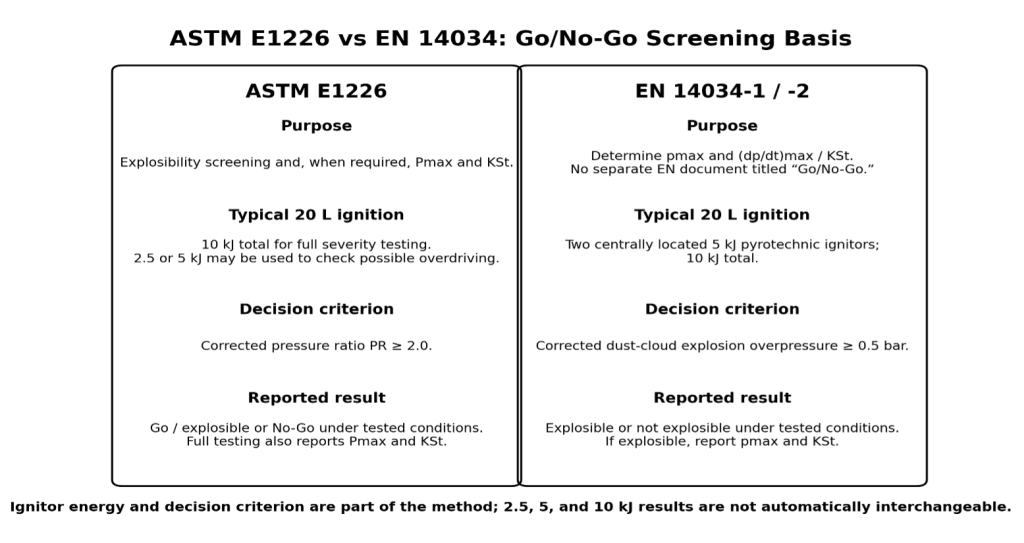
ASTM E1226 expressly includes an explosibility determination. The European EN 14034 series is organized around the measurement of explosion characteristics, particularly maximum explosion pressure and maximum rate of pressure rise. In practice, the EN test results also establish whether the tested dust cloud is explosible, but the terminology, ignition configuration, decision criterion, and reported result differ from ASTM.
Applicable Standards
- ASTM E1226-19(2025), Standard Test Method for Explosibility of Dust Clouds.
- EN 14034-1:2004+A1:2011, Determination of the Maximum Explosion Pressure pmax of Dust Clouds.
- EN 14034-2:2006+A1:2011, Determination of the Maximum Rate of Explosion Pressure Rise (dp/dt)max of Dust Clouds.
- EN 14034-3:2006+A1:2011, Determination of the Lower Explosion Limit LEL of Dust Clouds, where a concentration limit is required.
What the Go/No-Go Result Means
A Go result means that at least one tested dust concentration met the applicable deflagration-propagation or explosion criterion. The material is therefore capable of producing a propagating dust-cloud deflagration under the test conditions.
A No-Go or not-explosible result means that the applicable criterion was not met across the tested concentration range and specified test conditions. It does not prove that the material is noncombustible in every particle-size distribution, moisture condition, process temperature, oxygen concentration, or hybrid dust-vapor atmosphere.
ASTM E1226 Deflagration-Propagation Criterion
Under ASTM E1226, the screening decision is based on a corrected pressure ratio. A test is classified as Go when:
PR = (Pex,a – ΔPignitor) / Pignition ≥ 2.0
- Pex,a is the maximum absolute pressure measured during the dust test.
- ΔPignitor is the pressure contribution produced by the ignitor alone.
- Pignition is the absolute vessel pressure at the time of ignition.
If PR is less than 2.0, the individual test is a No-Go. A complete screening evaluation must cover a sufficient dust-concentration range so that testing only a lean or excessively rich cloud does not create a false No-Go.
European EN 14034 Explosion Criterion
The EN 14034 series does not use the ASTM corrected pressure ratio. Under the European approach, a test is treated as an explosion when the corrected explosion overpressure attributable to the dust cloud reaches at least 0.5 bar.
Corrected explosion overpressure ≥ 0.5 bar
A corrected pressure rise below 0.5 bar is not classified as an explosion for that individual condition. The test sequence must still evaluate a suitable concentration range. ASTM PR ≥ 2.0 and EN corrected overpressure ≥ 0.5 bar are different criteria and should not be mixed in one reported method.
Ignitor Type and Ignition Energy
Both approaches use centrally located pyrotechnic chemical ignitors in closed explosion vessels. Ignition energy can significantly influence marginal dusts, especially in a 20 L sphere, so the ignitor type, number, total energy, and vessel volume must be reported.
| Test configuration | 2.5 kJ | 5 kJ | 10 kJ | Recommended interpretation |
|---|---|---|---|---|
| ASTM E1226 in a 20 L vessel | Useful as a lower-energy check where a 5 or 10 kJ result may be overdriven. | May be used for screening or investigation, but a positive result that disappears at 2.5 kJ can indicate sensitivity to ignitor energy. | Commonly used for full Pmax/KSt testing; two 5 kJ ignitors may be used. Strong ignition can overdrive some weak dusts. | Report the result as Go/No-Go together with the exact ignition energy. Consider larger-vessel confirmation for marginal energy-dependent results. |
| EN 14034 in a 20 L sphere | Not the standard EN severity-test configuration. | One 5 kJ ignitor alone is not the usual EN 20 L arrangement. | Two centrally located 5 kJ pyrotechnic ignitors, 10 kJ total, are the standard EN configuration. | Report explosible/not explosible under EN criteria and, when explosible, the measured pmax and KSt. |
ASTM E1226 specifically warns that strong ignitors can overdrive weak dusts in a 20 L chamber. If measurable Pmax and KSt values are obtained with 5 or 10 kJ but not with an ignition source of 2.5 kJ or less, testing in a larger vessel, such as 1 m³ with at least 10 kJ, may be appropriate to characterize the material more reliably.
Typical Test Procedure
1. Prepare the sample
Document material identity, particle-size distribution, moisture content, preparation method, and tested condition.
2. Select the vessel and ignitor
Use a calibrated 20 L or larger near-spherical vessel and record the ignitor type, number, and total energy.
3. Test a concentration range
Disperse a sequence of nominal dust concentrations because very lean and very rich clouds may not propagate.
4. Record the pressure-time history
Measure the maximum pressure and apply the correction required by the selected standard.
5. Apply the standard-specific criterion
Use PR ≥ 2.0 for ASTM E1226 or corrected explosion overpressure ≥ 0.5 bar for EN 14034.
6. Report the result and limitations
Identify all Go and No-Go concentrations, sample condition, vessel, ignition energy, and the standard used.
Illustrative Sample Data
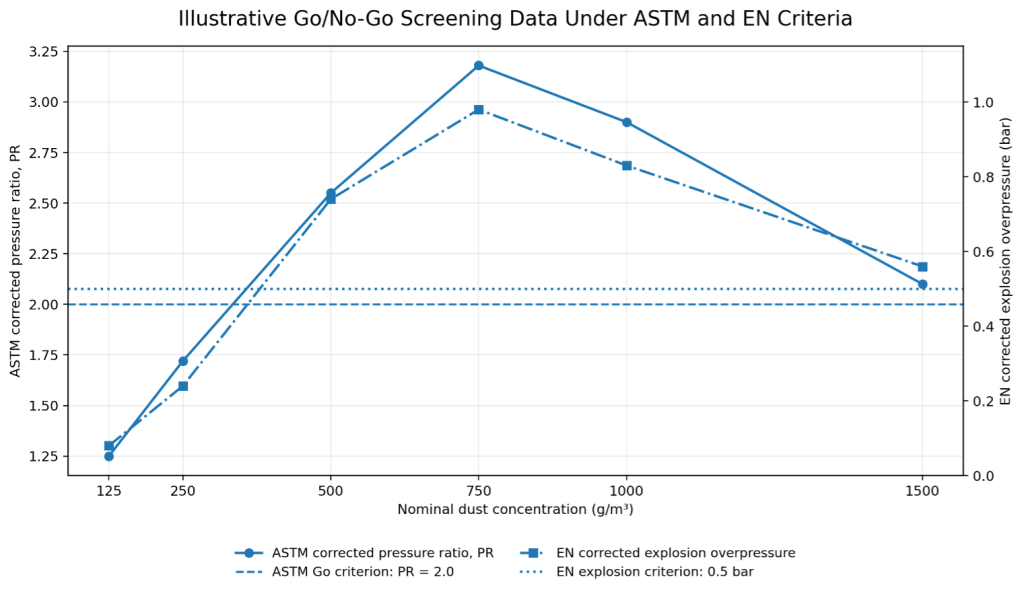
The following hypothetical data illustrate how one dust may satisfy both decision criteria at intermediate and high concentrations. The numbers are examples only and are not actual material data.
| Dust concentration (g/m³) | ASTM corrected PR | ASTM result | EN corrected overpressure (bar) | EN result |
|---|---|---|---|---|
| 125 | 1.25 | No-Go | 0.08 | Not explosible |
| 250 | 1.72 | No-Go | 0.24 | Not explosible |
| 500 | 2.55 | Go | 0.74 | Explosible |
| 750 | 3.18 | Go | 0.98 | Explosible |
| 1000 | 2.90 | Go | 0.83 | Explosible |
| 1500 | 2.10 | Go | 0.56 | Explosible |
How the Result Is Reported
ASTM E1226
For a screening evaluation, the principal reported conclusion is:
Go (explosible) or No-Go under the tested conditions
For the sample data, ASTM reports Go because at least one concentration has PR ≥ 2.0. When the full E1226 severity program is completed, the report also provides Pmax, (dP/dt)max, and KSt. A numerical PR is normally reported for each screening concentration, but PR itself is not the material’s explosion-severity index.
EN 14034
The EN 14034 series is primarily a quantitative explosion-characterization method rather than a separately named Go/No-Go screening standard. The report should state whether an explosion was observed under the EN criterion and, where the dust is explosible, report:
- pmax under EN 14034-1;
- (dp/dt)max and KSt under EN 14034-2; and
- the tested concentration range, vessel volume, and 10 kJ ignition configuration.
For the sample data, the European conclusion is explosible because the corrected explosion overpressure reaches or exceeds 0.5 bar at one or more concentrations.
ASTM Versus EN: Summary
| Technical item | ASTM E1226 | EN 14034-1 / -2 | |||||
|---|---|---|---|---|---|---|---|
| Primary purpose | Explosibility screening and explosion-severity characterization | Measurement of pmax and (dp/dt)max/KSt | |||||
| Typical 20 L ignition | 10 kJ for full severity testing; 2.5 or 5 kJ may be used to investigate overdriving | Two 5 kJ pyrotechnic ignitors; 10 kJ total | |||||
| Decision criterion | Corrected pressure ratio PR ≥ 2.0 | Corrected explosion overpressure ≥ 0.5 bar | |||||
| Screening language | Go / No-Go | Explosible / not explosible under test conditions | |||||
| Quantitative reported values | Pmax, (dP/dt)max, Kst when full testing is performed | pmax and KSt under EN 14034-1 and -2 | |||||
| Comparability | State vessel and ignition energy; weak dusts may be energy dependent | Do not convert directly to ASTM without accounting for method differences | |||||
How the Data Are Used
- Determine whether additional combustible-dust characterization is warranted.
- Support Dust Hazard Analysis screening and combustible-material inventories.
- Establish whether explosion venting, suppression, containment, or isolation design data are required.
- Trigger full Pmax/Kst, MEC, MIE, MIT-cloud, or MIT-layer testing as appropriate.
- Avoid treating a No-Go or not-explosible result as a universal exemption from combustible-dust controls.
Recommended Laboratory Report Content
- Standard and edition used
- Vessel type and volume
- Dust sample identity, particle size, moisture, and preparation
- Dust concentrations tested
- Ignitor type, number, and total energy
- Dispersion pressure and ignition delay
- Pressure correction method and decision criterion
- Individual results at each concentration
- Final ASTM Go/No-Go or EN explosible/not-explosible conclusion
- Pmax and KSt where a full severity program was completed
Conclusion
ASTM E1226 and the EN 14034 series address the same fundamental question—whether a dispersed dust cloud can produce a propagating deflagration—but they do not use identical terminology or criteria. ASTM uses the corrected pressure ratio PR ≥ 2.0 and may report a screening result as Go or No-Go. The European method uses a corrected explosion overpressure threshold of 0.5 bar and reports whether the dust is explosible under the test conditions, together with pmax and KSt when the full EN severity methods are performed. Ignitor energy must always be stated because 2.5, 5, and 10 kJ configurations can produce different results for marginal dusts.
How HazBasis Can Help
HazBasis Process Safety LLC helps manufacturers identify, quantify and control combustible-dust fire and explosion hazards.