Hazardous area classification should answer more than “What Zone is this?” A defensible study must establish where an explosive atmosphere can occur, why it can occur there, how frequently it may occur, how far the classified area extends, and what equipment requirements follow from that classification.
Quick Answer: What Is the Difference Between ATEX and IECEx?
ATEX and IECEx use many of the same explosive-atmosphere engineering concepts, but they are not interchangeable compliance systems. ATEX is part of the European Union legal framework. Directive 1999/92/EC addresses worker protection where explosive atmospheres may occur, while Directive 2014/34/EU addresses equipment and protective systems intended for potentially explosive atmospheres. IECEx, by contrast, is an international conformity-assessment system based on IEC standards.
| Topic | ATEX | IECEx / IEC |
| Primary role | European regulatory framework | International technical and conformity-assessment framework |
| Workplace explosive-atmosphere requirements | ATEX 1999/92/EC | Applicable national requirements supported by IEC-based engineering |
| Equipment requirements | ATEX 2014/34/EU | IECEx certification schemes based on IEC standards |
| Gas hazardous areas | Zones 0, 1 and 2 | Zones 0, 1 and 2 |
| Dust hazardous areas | Zones 20, 21 and 22 | Zones 20, 21 and 22 |
| Area-classification technical basis | Commonly supported by IEC/EN 60079-10 principles | IEC 60079-10-1 and IEC 60079-10-2 |
1. What Is Hazardous Area Classification?
Hazardous Area Classification (HAC) is the engineering process used to identify locations where flammable gas, vapor, mist or combustible dust may form an explosive atmosphere. A properly developed classification provides a design basis for ignition prevention, electrical equipment selection, installation, inspection, maintenance and management of change.

The objective is not to place a Zone label on a drawing as quickly as possible. A technically defensible classification documents the assumptions, process conditions, release scenarios, ventilation basis, material characteristics and engineering reasoning that establish each hazardous-area boundary.
2. Gas and Vapor Hazardous Areas: What Are Zones 0, 1 and 2?
IEC 60079-10-1 addresses classification of areas where flammable gas or vapor hazards may arise and provides a basis supporting proper design, construction, operation and maintenance of equipment used in hazardous areas.
| Classification | General Meaning | ATEX Category | EPL | |||
| Zone 0 | Explosive gas atmosphere is present continuously, for long periods, or frequently | 1G | Ga | |||
| Zone 1 | Explosive gas atmosphere is likely to occur occasionally during normal operation | 2G | Gb | |||
| Zone 2 | Explosive gas atmosphere is not likely during normal operation and, if it occurs, exists only for a short period | 3G | Gc | |||
| Process Location | ZONE 0 | ZONE 1 | ZONE 2 |
|---|---|---|---|
| Vessel vapor space | Continuous / frequent explosive atmosphere | — | — |
| Normal vent / primary release | Inside process equipment | Immediate region around normal release | Outer region if short-duration cloud is credible |
| Pump seal / secondary release | — | — or limited if normal release is credible | Area where infrequent, short-duration release may occur |
Zone designation is based principally on the expected frequency and duration of the explosive atmosphere. It does not, by itself, establish the physical distance of the classified area. A Zone 2 boundary, for example, should not be selected simply by applying a generic radius around every pump seal, flange or vent.
3. What Determines Hazardous Area Zone Extent?
The physical extent of a hazardous area depends on the actual release and dispersion conditions. Two facilities handling the same solvent can legitimately have very different classified-area boundaries.
- Release rate and duration
- Process pressure and temperature
- Opening or release size
- Vapor pressure and relative vapor density
- Ventilation effectiveness and dilution
- Indoor versus outdoor location
- Congestion, enclosure geometry, pits, trenches and low points
- Credible ventilation failure or degradation
Ventilation Is Especially Important
A specified number of room air changes per hour does not automatically prove that a flammable release is adequately diluted. The important questions are where the release occurs, where the air actually moves, whether ventilation is available when the release occurs, and whether vapor can accumulate in stagnant or enclosed regions.
4. Combustible Dust Hazardous Areas: Zones 20, 21 and 22
Combustible dust requires a different evaluation because both explosive dust clouds and combustible dust layers can affect ignition risk. IEC 60079-10-2:2026 addresses identification and classification of areas where explosive dust atmospheres and combustible dust layers may be present. The standard treats explosive dust atmospheres and combustible dust layers separately while recognizing that dust layers can also act as sources of release.
| Classification | General Meaning | ATEX Category | EPL | |||
| Zone 20 | Explosive dust atmosphere is present continuously, frequently, or for long periods | 1D | Da | |||
| Zone 21 | Explosive dust atmosphere is likely to occur occasionally during normal operation | 2D | Db | |||
| Zone 22 | Explosive dust atmosphere is unlikely during normal operation and, if present, persists only briefly | 3D | Dc | |||
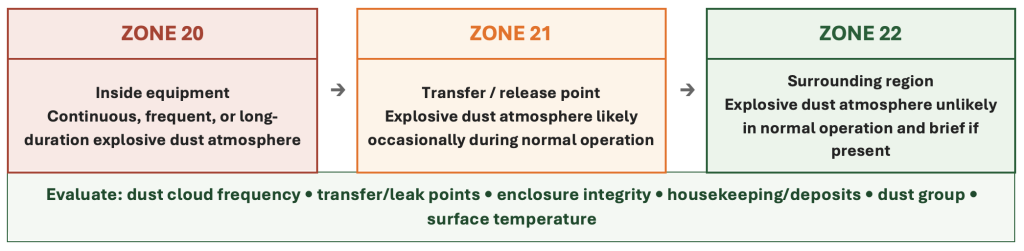
A dust collector, mill, grinder, blender, dryer, silo, hopper, filter receiver or pneumatic conveying system may have one classification internally and a completely different external classification.
“Enclosed” does not automatically mean “unclassified”
Flexible connections, rotary valves, bag-dumping stations, filter changes, inspection openings, powder filling, housekeeping practices, maintenance activities and loss-of-containment events can create external dust clouds or deposits. Dust zoning should be coordinated with the facility Dust Hazard Analysis and combustible dust test basis where applicable.
5. How Is a Professional Hazardous Area Classification Performed?
A strong classification begins with the process and release mechanism rather than with a desired Zone designation.
Step 1 — Establish the Material Hazard Basis
For gases and vapors, relevant information can include flash point, vapor pressure, flammable limits, autoignition temperature, relative vapor density and gas group. For combustible dusts, the required information may include explosibility, ignition sensitivity, particle size, conductivity characteristics, dust group, dust-cloud ignition temperature and dust-layer ignition behavior. Missing or inappropriate material-property data can lead directly to incorrect zoning, temperature limits or equipment selection.
Step 2 — Identify Credible Sources of Release
Identify where flammable material can realistically enter the surrounding atmosphere. Typical sources may include tank vents, pump and compressor seals, process openings, valves, sampling points, drains, loading and unloading connections, relief systems, dust-collector openings, rotary valves, bag dumping, powder transfer and filling operations. The presence of a flammable or combustible material somewhere in a room does not by itself define the classified boundary.
Step 3 — Determine Release Characteristics
For gases and vapors, evaluate release grade, release rate, duration, pressure, temperature, physical state and process conditions. For dust processes, evaluate the frequency and duration of dust-cloud formation, external release, accumulation, containment and dust-layer conditions.
Step 4 — Evaluate Ventilation, Dilution and Accumulation
Evaluate actual airflow and geometry rather than relying exclusively on nominal ventilation capacity.
Step 5 — Establish Zone Type and Physical Extent
Document Zone boundaries clearly enough to be understood and applied by electrical engineers, EPC firms, equipment suppliers, contractors, inspectors, operations personnel and project reviewers.
Step 6 — Define the Equipment Selection Basis
Translate the classification into requirements for Zone/EPL or ATEX category, gas or dust group, temperature class or allowable surface temperature, environmental conditions, protection concept and installation requirements.
6. Gas Groups IIA, IIB and IIC
| Gas Group | Typical Reference | Equipment Implication | ||||
| IIA | Propane-type hydrocarbon applications are common examples | Least demanding within the IIA/IIB/IIC hierarchy | ||||
| IIB | Ethylene is a common reference example | Equipment suitable for IIB or IIC may be required | ||||
| IIC | Includes hydrogen and acetylene | Most demanding within the IIA/IIB/IIC hierarchy | ||||
Gas group is only one part of equipment selection. Zone, EPL, temperature classification, ambient conditions, protection technique and certificate limitations must also be checked.
7. Dust Groups IIIA, IIIB and IIIC
| Dust Group | General Description | ||
| IIIA | Combustible flyings | ||
| IIIB | Non-conductive dust | ||
| IIIC | Conductive dust | ||
Conductive dusts can create additional equipment and electrical considerations, so equipment suitability must be assessed against the actual dust group. Where adequate material data are unavailable, representative laboratory testing can be an important input to the classification and ignition-hazard basis.
8. Temperature Classes T1 Through T6
| Temperature Class | Maximum Surface Temperature | |
| T1 | 450°C | |
| T2 | 300°C | |
| T3 | 200°C | |
| T4 | 135°C | |
| T5 | 100°C | |
| T6 | 85°C | |
For combustible dust applications, equipment markings commonly specify a maximum surface temperature directly. Dust layers require additional attention because accumulated material can thermally insulate equipment surfaces and alter the ignition hazard.
9. How to Read an Ex Equipment Marking
Consider the gas equipment marking:

A Common Purchasing Error
“ATEX certified,” “IECEx certified,” or “Ex rated” is not a complete equipment specification. Equipment must be suitable for the actual Zone, EPL/category, gas or dust group, maximum surface-temperature requirement, ambient range, environmental conditions, protection concept, installation method and certificate limitations.
IEC 60079-14:2024 addresses electrical installation design, selection and installation of Ex equipment and associated initial inspection requirements.
10. Hazardous Area Classification Does Not Address Every Ignition Source
Installing appropriately rated electrical equipment does not automatically make a process safe from ignition. Potential non-electrical ignition mechanisms can include hot bearings, friction, mechanical sparks, impact, belt slip, overheating, rotating-equipment failure and electrostatic discharge.
- Use an Ignition Source Analysis when moving components, hot surfaces, friction, impact or mechanical failure modes are credible.
- Use an Electrostatic Hazard Analysis when the process involves powder transfer, nonconductive liquids, plastic components, FIBCs, hoses, filters, insulating surfaces or other charge-generating operations.
11. Seven Hazardous Area Classification Mistakes That Can Create Risk or Unnecessary Cost
1. Classifying an Entire Room Without Evaluating Release Sources
Over-classification can create unnecessary capital and lifecycle costs. Classified boundaries should follow defensible release and dispersion analysis.
2. Assuming “ATEX Certified” Means Suitable Everywhere
Certification must match the actual Zone, EPL/category, material group, temperature requirement, ambient range and installation conditions.
3. Ignoring Ventilation
Ventilation and dilution can have a major influence on Zone extent.
4. Assuming an Enclosed Dust Process Cannot Produce an External Hazard
Flexible connections, bag dumping, filter changes, rotary valves and maintenance operations can create dust releases outside normally enclosed equipment.
5. Classifying From the SDS Alone
An SDS does not establish process-specific release geometry, operating pressure, opening size, ventilation or hazardous-area extent.
6. Copying the Classification Drawing From Another Facility
Even two plants processing the same chemical can have different classifications because release and ventilation conditions differ.
7. Evaluating Electrical Equipment but Ignoring Non-Electrical Ignition Sources
Static electricity, hot surfaces, friction, mechanical sparks and equipment malfunction must be evaluated separately where credible.
12. ATEX / IECEx vs. NEC Class and Division: Which System Should You Use?
Many U.S. facilities are more familiar with the NFPA/NEC Class and Division approach, while international projects frequently use the IEC Zone framework. The correct system depends on project location, adopted electrical code, owner requirements, client specifications, equipment-supply requirements and the Authority Having Jurisdiction.
HazBasis maintains separate engineering service paths for IEC Hazardous Area Classification and NFPA/NEC Hazardous Area Classification, allowing the classification framework to be selected based on the actual project design basis rather than forcing every facility into one system.
13. When Should a Hazardous Area Classification Be Updated?
A classification should be reviewed whenever the assumptions that established it may have changed. Typical triggers include:
- Performing a PHA, HAZOP, DHA or significant management-of-change review
- Designing a new plant or process area
- Installing or relocating process equipment
- Adding a flammable liquid, gas or combustible powder
- Changing process pressure or temperature
- Changing general or local exhaust ventilation
- Increasing production rate or inventory
- Changing process layout or release-point locations
- Replacing general-purpose equipment in a potentially classified area
- Importing equipment carrying ATEX or IECEx certification
- Responding to an AHJ, insurer or corporate audit concern
- Investigating a fire, explosion or near miss
Practical rule
Your hazardous-area drawing should represent the plant that exists today—not the plant that existed when the original electrical drawings were issued years ago.
14. What Should a Professional Hazardous Area Classification Report Include?
| Deliverable Element | Expected Content | |
| Process and material basis | Materials, process conditions and relevant properties | |
| Applicable standards | IEC/EN, ATEX, national codes and project requirements | |
| Sources of release | Location and operating basis for each release | |
| Release classification | Continuous, primary, secondary or applicable dust basis | |
| Ventilation evaluation | Natural/mechanical ventilation, dilution, availability and geometry | |
| Zone classification | Zone 0/1/2 or Zone 20/21/22 | |
| Zone extent | Physical boundaries in plan and elevation where required | |
| Material group | IIA/IIB/IIC or IIIA/IIIB/IIIC | |
| Temperature requirement | T-class or maximum allowable surface temperature | |
| Equipment implications | Electrical, instrumentation and non-electrical requirements | |
| Drawings | Clear hazardous-area classification drawings | |
| Recommendations | Practical improvements where gaps are identified | |
15. Can Better Engineering Reduce the Size of a Classified Area?
Sometimes—but reducing the Zone should never be the starting objective. The objective is to reduce the probability, rate, duration or persistence of the explosive atmosphere through legitimate engineering improvements and then reassess the classification based on the improved process.
- Improved process containment
- Closed-transfer systems
- Better local exhaust or general ventilation
- Relocation of vents or release points
- Routing vents outdoors or to a safe system
- Vapor recovery
- Improved dust collection and enclosure integrity
- Improved seals and mechanical design
- Process enclosure or layout changes
The correct target is neither maximum classification nor minimum classification. It is technically justified classification.
16. Hazardous Area Classification Should Be Integrated With Process Safety
| Process Safety Activity | Connection to HAC | |
| PHA / HAZOP | Identifies credible process deviations and releases that may affect classification | |
| Dust Hazard Analysis | Connects dust zoning with fire/explosion hazards, housekeeping and explosion protection | |
| Electrostatic Hazard Analysis | Evaluates static ignition mechanisms that Ex electrical equipment does not eliminate | |
| Ignition Source Analysis | Evaluates electrical and non-electrical ignition sources in classified areas | |
| Combustible Dust Testing | Provides material data needed for dust classification and ignition-risk decisions | |
| Management of Change | Triggers HAC review when materials, equipment, ventilation or operating conditions change | |
This integrated approach supports HazBasis’s broader process-safety model: engineering-led consulting and in-house laboratory testing are connected rather than treated as isolated disciplines.